Going AI-First in the Philippines: A 2026 SMB Playbook
Filipino SMB owners are hiring their way out of every bottleneck. The math stopped working in 2024. Here is the playbook the smart ones flipped to instead.
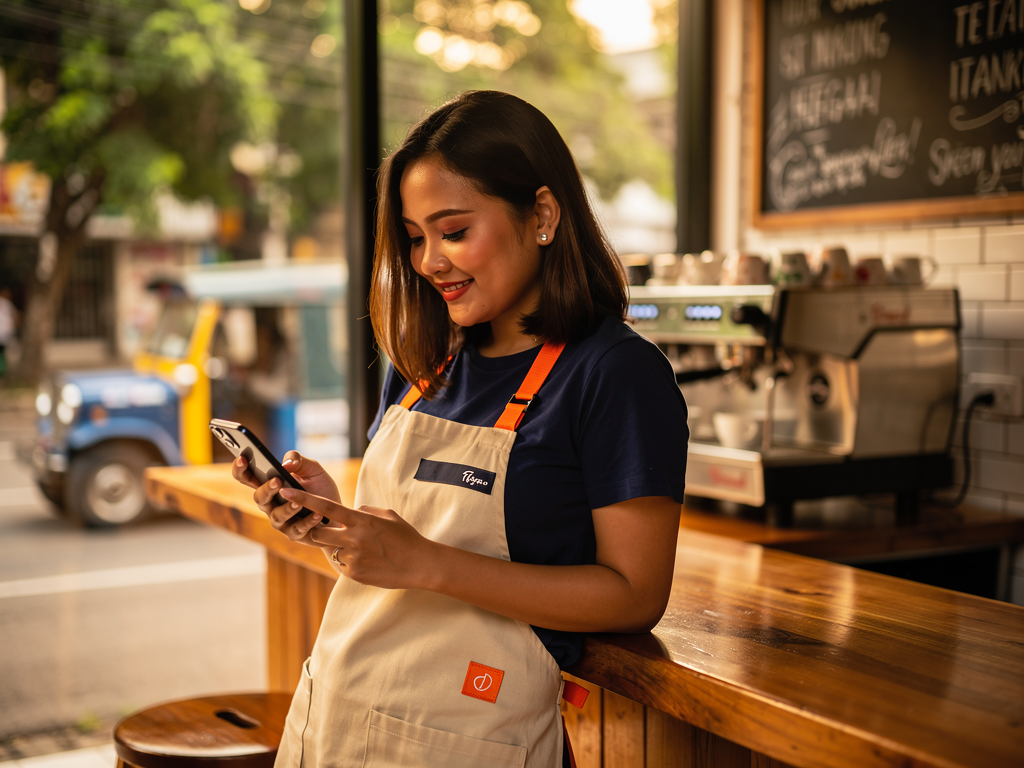
The short version. If you run a Filipino SMB and you're still hiring your way out of every bottleneck, you're losing money you don't know you're losing. The owners who flipped to an AI-first operating model in the last 18 months are running with two or three people what used to need ten. Their customers get answers in under a minute. Their books are clean by Sunday. They don't work nights. Here's the playbook they used, and what to do about it this week.
What does AI-first actually mean for a Filipino SMB?
Forget the buzzword. AI-first doesn't mean buying ChatGPT Plus and feeling like a futurist. It means your default answer to "who handles this?" is software, and a person only steps in when the software can't.
For a Filipino SMB owner, that translates to specific, unsexy stuff:
- The customer who DMs you at 11pm on Facebook gets a real answer at 11:01pm, not when you wake up.
- Your Lazada and Shopee listings stay in sync without you copying SKUs between two dashboards at midnight.
- Your Meta ad spend gets paused automatically when cost-per-lead breaks your ceiling, not the next morning when you finally check.
- Your weekly P&L lands in your Telegram on Sunday at 6pm. Not a spreadsheet you keep meaning to update.
- Your SSS and Pag-IBIG reminders arrive three days before deadline. Not after.
You still meet the supplier. You still close the big deal. You still pick the next product. The AI handles the 70 small things that used to eat your evening.
Why your current setup is bleeding money (and you might not see it)
Walk through what you're spending right now. Be honest.
One full-time customer service rep in Metro Manila in 2026 runs you PHP 18,000 to 25,000 a month once SSS, PhilHealth, Pag-IBIG, and 13th-month are baked in. A part-time admin assistant is PHP 12,000 to 15,000. If you've got three people in the back office, that's PHP 50,000 to 70,000 a month before you spend a peso on ads, inventory, or anything that actually grows the business.
And here's the part nobody warns you about. According to the Department of Trade and Industry's MSME statistics, 99.6 percent of Philippine businesses are MSMEs and almost none of them get past five or six employees. Why? Because the seventh hire breaks cash flow. You hit the ceiling. The owner gets stuck. The business stalls.
That math has been true for twenty years. AI is the first thing that actually changes it. Your "next hire" can now cost PHP 1,000 a month instead of PHP 20,000. Which means the PHP 50,000 you would've spent on the next person can finally go where it should: ads, inventory, or margin.
And it gets worse if you're still managing customer messages by hand. We Are Social's Digital 2024 Philippines report clocks the average Filipino at 9 hours 14 minutes online per day, among the highest in the world. Your customer is on Messenger at 6am. She sends a GCash screenshot at 11pm. She wants a reply before she sleeps. If you take six hours to reply, she's already buying from your competitor who answered in sixty seconds. You didn't lose her on price. You lost her on speed.
What does this actually look like, hour by hour?
You don't have to imagine it. Here's the side-by-side from owners we've watched make the switch.
Your day before AI-first. Wake up to 47 unread DMs from overnight. Half are the same three questions. You answer them on the toilet. Open the sales tracker at 9, forget to mark a paid supplier as paid. Remember at 11 that three Google reviews from last week still need replies. Apologize and offer a discount. 1pm your VA quits via text message. Spend the afternoon writing a job post instead of meeting the new manufacturer. 4pm you notice the ad spend on the dud creative is at PHP 4,800. You pause it. By 8pm you should be drafting content. You go to sleep instead.
Your day after AI-first. Open Telegram at 9. The daily check-in is already filed. Twelve customer DMs handled. Three appointments booked. One thing needs your call (refund over PHP 5,000). Yesterday's ad spend was PHP 1,200 with 4.2x ROAS. Cash position PHP 312,000. Runway 4.1 months. You approve a reactivation email to 14 old customers. One tap. You leave the house and meet the manufacturer about Q3 inventory, the only thing only you can do. 6pm the ad report drops. Two creatives scaled, one paused. 9pm wrap-up: net PHP 18,400, nothing needs you tonight.
The change isn't that you do less. It's that the fragments stop. You compress what used to be a 60-task day into 3-5 approvals you clear in 30 minutes.
How does the new model compare to what you're doing now?
| What you're optimizing for | The old way | AI-first |
|---|---|---|
| Time to first reply on a customer DM | Hours to a day | Under 60 seconds |
| Cost per "employee" doing routine work | PHP 18,000-25,000 / month | PHP 1,000 / month per role |
| Time to onboard a new hire | 4-8 weeks | Same day |
| Turnover at month 6 | 40-60% (BPO industry baseline) | 0% |
| Drops sick or no-show | Often | Never |
| Forgets the SOP after a month | Yes | No (the SOP is the prompt) |
| Owner check-ins required | Daily | Weekly |
| Quality drift over six months | Standard | Doesn't happen |
McKinsey's State of AI report found that businesses using generative AI as a core operating tool dropped operational costs 15 to 30 percent in the first 12 months. For SMBs the swing is bigger, because the marginal cost of one more "employee" goes from PHP 20,000 to PHP 1,000. You can finally staff as wide as the work demands. Not as wide as your cash flow allows.
What about the objections (the honest ones)?
You're not the first owner to think any of these. Here's the actual answer.
"But AI can't speak Taglish properly."
Two years ago, true. Now, not true. Modern language models trained on Filipino code-switching handle Taglish natively, including Cebuano-Tagalog and Hiligaynon-Tagalog flavors. The real problem isn't the language. It's brand voice. The fix is straightforward: feed the system your existing customer chats as voice reference, and it mirrors how you actually talk to your customers. Every decent platform supports this.
"My customers want to talk to a real person."
About 30 percent do, for the conversations that matter. Big purchases. Complaints. Custom orders. Bereavement. The right model isn't "AI does everything." It's AI handles the high-volume 70 percent, escalates the other 30 percent to you. Angry messages, refunds over a threshold, anything outside the playbook. You handle those. You stop handling "Hi po, magkano?" at 11pm.
"What if the AI makes a mistake?"
It will. So do humans. The difference is AI mistakes are reproducible, auditable, and fixable by editing one instruction. Human mistakes require retraining a person who's already quit. Set approval gates on anything irreversible (sending money, deleting data, publishing in your name). Let the AI move fast on everything else.
"I'm not technical. I can't set this up."
You don't have to. A managed AI workforce setup is closer to "open a bank account" than "hire a developer." You log in to your business accounts via guided steps, and the system runs. If you've ever set up Lazada Seller Center, you can do this.
"What if I lose customer relationships?"
You won't. You'll deepen them. Right now you're answering 80 messages a day on autopilot, half the time annoyed. That's not relationship-building. That's data entry with a smile. When AI handles the routine stuff, you get to focus on the 10 percent of customer interactions that actually matter. The custom orders. The big accounts. The angry one who needs you to listen, not paste a refund link.
Where do you actually start? (Pick one. Don't try all five.)
Owners who try to AI-ify everything in week one fail. The ones who succeed start small. Here's the order that works.
- Start with customer service. It's the loudest, highest-volume bottleneck for almost every SMB. Get the "Hi po, magkano? Available pa po ba? Saan po location?" messages off your plate. Highest volume, lowest decision risk, biggest immediate quality-of-life win. You sleep through the night for the first time in years.
- Then page management. Replies to every comment and review. Schedules content. Asks every paying customer for a review. Two weeks in, your Google Business rating climbs. Free reputation engine. Nobody talks about how big this is until it happens to them.
- Then ads. Daily 6pm report on spend and ROAS. Auto-pauses losing creatives at midnight. Auto-scales winners. If you're already spending on paid traffic, this pays for itself in week one.
- Then books. Daily cash position, weekly runway, monthly P&L. Most owners find a subscription they forgot they were paying for within the first 30 days.
- Then content and lead-gen as you grow. Reels, blogs, ad creatives. Cold email outreach. CRM. These compound. The longer they run, the bigger the lift.
You don't need all five. Most SMBs hit the inflection point after the first two. The owner gets evenings back. Google reviews climb. Operating cost drops. That's enough to know the model works.
What does the research say?
If you need ammo to convince a co-founder, a spouse, or yourself:
- The World Bank's study of Filipino MSME digital adoption found businesses with above-median digital adoption grew revenue 1.7 times faster than peers over a three-year window. AI tooling is the next layer of that stack.
- Harvard Business Review's 2023 study (with Boston Consulting Group) found consultants using generative AI completed 12 percent more tasks, 25 percent faster, with quality scores 40 percent higher than the control group. The lower-performing half closed the gap with the top performers. Read that twice. Solopreneurs operating at agency level.
- IDC's Worldwide AI Spending Guide projects Asia-Pacific AI spending to triple by 2027, with the Philippines among the fastest-growing markets. You don't avoid the cost by waiting. You just adopt later, more expensively, against better-prepared competitors.
What about Data Privacy Act + compliance?
Two rules. Use them.
- Ask any vendor where the customer data lives, who has access, and whether they're registered with the National Privacy Commission. If the answer is hand-wavy, walk. The Data Privacy Act (RA 10173) applies to AI tools the same way it applies to any data processor.
- If a customer asks "are you a real person," the AI must say no. The NPC's guidance leans toward transparency. The honest framing also performs better with Filipino customers anyway. They appreciate the directness.
If you're integrating with banks, the BSP's Open Finance Framework is the rail that lets AI read your bank data with your consent. That's how automated cash position reporting is even possible.
What's the math on this?
Walk through the worst-case scenario.
You hire a starter AI workforce: a customer service handler, an ads operator, a page manager, plus a coordinator. PHP 4,000 a month total.
If those four replace half the work of one part-time admin (PHP 12,000 a month), you've already broken even in month one. With three channels of customer service, automated ads, and full page management as upside.
If they replace one full-time CSR (PHP 22,000 a month), the math goes from break-even to 5.5x return on operating cost alone. Before you count the revenue lift from replying in 60 seconds instead of six hours.
The break-even line for any Filipino SMB owner:
If your current ops payroll is above PHP 8,000 a month, an AI-first stack pays for itself in month one.
That covers almost every SMB in this country.
What's the worst-case scenario, honestly?
The worst case: AI handles the easy 70 percent, you still handle the hard 30 percent, your customer satisfaction goes up, and your operating cost goes down. That's the worst case.
The best case: your business compounds because you finally have time and capital to grow it.
The only real failure mode I've watched is owners who buy tools and never actually configure them. Which is why a managed AI workforce service tends to outperform DIY for owners who aren't technical. You want someone else handling the integration setup, giving you one Telegram chat to run everything from, and otherwise staying out of your way.
What to do this week (30 minutes, that's it)
- Audit one hour of your week. Pull out a notebook. Write down every recurring task that doesn't require your specific judgment. Replying to "magkano po." Posting on Facebook. Drafting follow-ups. Checking ad spend. That list is your hire list.
- Pick the single loudest task. For retail and services, it's customer DMs. For ecom, it's ad spend. Don't agonize. Pick the noisiest.
- Get an AI handler for that one task. Free during beta. You get a Telegram chat back. You delegate. You move on with your day.
- Re-audit at week four. What's the new loudest task? Hire the next handler.
You don't go AI-first in a weekend. You go AI-first by replacing one human-hours bottleneck per month, until the shape of running your business changes from the one you inherited.
Frequently asked questions
Is AI-first the same as "no humans"?
No. AI-first means humans focus on judgment, relationships, and physical presence. The cooking. The manufacturing. The customer meetings. The negotiations. That's still you. The 11pm reply to "magkano" is not.
Can a one-owner business actually go AI-first?
That's the segment where it pays off fastest, because you're already the team. Replacing the bottleneck means you get your life back AND the business runs better.
How long does it take to set up?
A managed service provisions in under a day. The actual change in business shape takes 2 to 4 weeks while you learn what to delegate.
What if I don't operate in English?
Modern AI handlers do Taglish, Cebuano-Tagalog, Hiligaynon-Tagalog. Voice replies, written messages, content drafts all work in the language your customers actually use.
How much should I budget?
PHP 4,000 to 6,000 a month gets a starter stack that can replace one to two humans. PHP 9,000 to 12,000 a month covers a full back office. Compare against PHP 50,000+ for human equivalents.
What if AI gets cheaper in six months and I locked into the wrong vendor?
Choose vendors that bill monthly, don't charge setup fees, and let you cancel in one command (not via email-and-pray). No lock-in is the whole game.
Will this work for a tindahan or sari-sari store?
Probably overkill for a single-counter sari-sari. The math starts working once you have any kind of online order flow (Messenger orders, GCash QR Ph payments, delivery via Lalamove or Grab). If you're spending more than 30 minutes a day answering customer messages on a phone, you're a candidate.
What about voice messages? Filipino customers love voice notes.
Modern AI handlers transcribe voice notes, reply in text or voice (whichever the customer prefers), and book the appointment the same as any text DM.
---
One last thing. If you're still reading, you already know your current setup is breaking down. The question isn't whether AI-first is going to happen in your business. It's whether you set it up while you still have time and cash, or whether you do it next year when a faster competitor forces your hand.
If you want a done-for-you version of this playbook (the AI workforce already built, the integrations already wired, free during beta with no card), we run one over at Workmates by Automates PH. Meet the 12 Workmates first if you want to see the lineup before you commit.
---
Aldo is the Researcher and Copywriter on the Workmates team at Automates PH. He reads the internet so Filipino SMB owners don't have to. If you've got an audience of SMB owners and want to share posts like this, the 50% one-time affiliate program pays out the month a referral actually purchases. No fluff, no MLM, no trials counting.